"Pat’s ability to see beyond our workaday horizon was a gift rarely accorded. Acknowledging her influence and aspiring, in respect to her life work and passion, to build a better world than what we have been given ennobles us; we wholeheartedly embrace a vision that invites her spirit to reside with us still." --Charles Henry , https://www.clir.org/2019/05/pat-battin-and-evocative-leadership/
Patricia Meyer Battin, 1929-2019
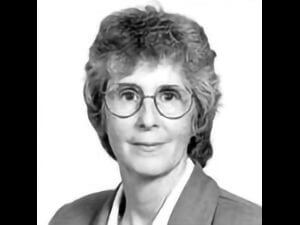
Pat Battin was clearly one of the most influential librarians of the 20th century and into the 21st. Rather than quote sources, which instead are listed below, I have decided that the tribute to her by Charles Henry is the best possible memorial for her, and is here in its entirety:
My first impression of Pat Battin: how extraordinary her writing. Elegant and candid, weaving apt metaphors and at times colloquial interjections that enlivened an otherwise formal expression, she was for me instantly persuasive. Working within an academic culture that valued sharp articulation but often succumbed to clausal pile-ons and obscure phrasing in its flurry of memos, missives, and calculated interdepartmental letters, Pat’s correspondence shined. This was Columbia University in the mid-1980s, a campus still wrestling with its identity after the student protests and bloody police interventions of the late 1960s. And it was about to be roiled again. The digital revolution was underway, and the humanities were unprepared. As a doctoral candidate in comparative literature at the time, I can attest to that unequivocally.
As vice president and university librarian, Pat was laying the groundwork for Columbia’s first online catalog and was deeply interested in the implications of computers for research and teaching. Writing a dissertation that relied on electronic tools and print resources, I was emblematic of an evolving humanities community and served as an informal advisor to her. Pat’s decision to hire me in 1985 as assistant director of the humanities and history division of Columbia’s libraries profoundly influenced my professional life, instigating and steering the next 30 years of my career. It was also a risk, given my paucity of administrative experience, but Pat did not see it that way. She was far more concerned with traditional rules of intellectual engagement and strategy, and the disruptive nexus of those inherited modes of inquiry with emerging machines and their software and new algorithms. Working with her, I was quietly mentored: thoroughly unsentimental, rigorous, cordial but never chummy (“I don’t schmooze,” she would say), loyal to her hires, and unconditionally focused on creating a better future. These characteristics became instilled.
Her remaining years at Columbia were groundbreaking: the new electronic catalog came online; digital technology, sometimes haltingly but assuredly, became more integral to the humanities departments, and through a political quirk—the head of academic computing ran for and won a position in public office and resigned—Pat took charge of information technology and the libraries, an early national precedent that remains successfully in place today.
Pat left Columbia to become president of the Commission on Preservation and Access (CPA), a predecessor to CLIR (CLIR was inaugurated in 1997 by the merger of CPA and the Council on Library Resources). In her introduction to the CPA annual report 1991–92, Pat exhorted her constituency to recognize “the need to insure continuing access to prospective information stored on and transmitted via rapidly changing electronic media.” She added that CPA’s technological explorations were “driven by the conviction that technology continues to change both scholarly research methodologies and information needs and habits. It is essential that the knowledge from the past that we preserve today meets the needs of future scholars.”
These words continue to impress me. They succinctly describe the fundamental transformations of digital technology that include not just the manner by which content is preserved and made accessible but also the way scholarship is structured and executed. Contemporary methods will invariably change and we need, as a profession, to be able to think, however imperfectly, as future researchers and teachers who will be responsible for the continuity of our cultural heritage. Assuring this continuity is our chief responsibility: we are stewards of the past, managers and strategists of the present, and are required to approximate the life of the mind of those who will follow us. This formulation for the provision of library service is bracing.
Following her tenure at CPA, Pat worked for several years at Emory University, where she was one of the co-founders of the Frye Leadership Institute, which continues to flourish and evolve as the Leading Change Institute. One of her many contributions to the Frye program was the establishment of the Patricia M. Battin Scholarship. Pat’s original concept for the award was, as always, prescient and empathetic. In her words, the scholarship “was created to provide tuition assistance for individuals whose institutions lack funding, and its purpose is to foster ethnic, racial, and gender diversity, as well as diversity in professional and scholarly background or type of institution.”
Pat Battin was the most temperate, empathetic, and generous revolutionary I ever met. “We have not yet begun to fight!” she stated in her essay that described the new agenda of the CPA when she took charge. Her mission, as polished and engaging as her prose, remains sustaining. While we mourn her passing, the principles that guided her career infuse CLIR. Her leadership was evocative: she expressed ideas, issues, and premonitions with a rare clarity that stirs feelings and our curiosity to learn more. Her core principles—an unwavering belief in the power and efficacy of collaboration; her insistence on rigorous research that leads to shared solutions; the potential transcendence of communities of practice, as opposed to the lone practitioner; an egalitarian world view; and a commitment to serving the public good—provide us with navigational light today.
Pat’s ability to see beyond our workaday horizon was a gift rarely accorded. Acknowledging her influence and aspiring, in respect to her life work and passion, to build a better world than what we have been given ennobles us; we wholeheartedly embrace a vision that invites her spirit to reside with us still. Though she would probably think this eulogy somewhat uneven and sentimental, I would respond that it is true, and it is from the heart. Pat, your friendship endures as a source of inspiration.
By Charles Henry, https://www.clir.org/2019/05/pat-battin-and-evocative-leadership/
Submitted by Susan K. Martin
Sources:
Kaylyn Groves, Memorial: Patricia Battin, 1929-2019, https://www.arl.org/news/memorial-patricia-battin-1929-2019/
Wikipedia, https://en.wikipedia.org/wiki/Patricia_Battin
Patricia Battin obituary, 2019. https://www.legacy.com/us/obituaries/washingtonpost/name/patricia-battin-obituary?id=1810425
Katharine Q. Seelye, “Patricia Battin, Lightning Rod in a Library War, Dies at 89”, New York Times, June 5, 2019 (https://www.nytimes.com/2019/06/05/obituaries/patricia-battin-dead.html)
In honor of the Sesquicentennial (150th Anniversary of ALA) in 2026, the Library History Round Table is hosting Librarians We Have Lost, Sesquicentennial Memories -1976-2026. This collage of tributes seeks to honor librarians who died between 1976-2026. The tributes are published to ALA Connect, a digital memorial on LHRT News & Notes, and ALA's institutional repository (ALAIR).
We invite tributes from anyone about any library worker who passed away between 1976-2026. To submit a tribute, please use the form at https://lhrt.news/librarians-we-have-lost-sesquicentennial-memories-1976-2026-2/
For questions or comments, please reach out to Dr. Kathleen McCook (kmccook@usf.edu) or Brett Spencer (dbs21@psu.edu).
-------------------------------------------
------------------------------
Brett Spencer
Reference Librarian
Thun Library, Penn State Berks
He/Him/His
------------------------------