Miriam Matthews (1905–2003) was a pioneering African American librarian and advocate for racial equity, intellectual freedom, and Black history in Los Angeles. Born in Pensacola, Florida, her parents moved to California when she was a child of two to escape segregation. After excelling at Los Angeles High School, she earned a Spanish degree from UC Berkeley and entered librarianship in 1927, becoming the first Black librarian employed by the Los Angeles Public Library. She rose through the ranks, leading branches like Helen Hunt Jackson, where she launched book clubs, radio reviews, and a personal collection of African American history, which later became a national resource. Matthews championed Negro History Week (now African American History Month), fought against censorship, and advocated for inclusive library collections. She earned a Master's in library science from the University of Chicago, becoming a Regional Librarian in 1949, a role she held until retiring in 1960. Post-retirement, she continued activism, including leading efforts to honor Los Angeles' diverse founding pobladores with a monument recognizing African descent among them. A prolific art collector focused on Black artists, her works were displayed in major museums. Matthews' legacy includes the renaming of the Hyde Park Library in her honor (2004) and her collection being archived at UCLA. Inducted into the California Library Hall of Fame in 2012, she is celebrated as the "Dean of Los Angeles Black History" for her lifelong dedication to libraries, equity, and preserving the city's multicultural narrative. Her work continues to inspire efforts toward inclusive education and historical representation.
Her achievements and contributions are wide-ranging and genuinely remarkable, but this tribute focuses on one specific thread: her work as part of a trio of advocates at the intersections of intellectual freedom and racial justice during a pivotal time in the history of the American Library Association. This is the intellectual connection I feel with Miriam and why I am writing this tribute. Her work resonates in the summer of 2026 as we mark our nation's 250th anniversary.
The 1940s Loyalty Oaths and the "Trio of Advocates" Who Led the ALA Bill of Rights Revision
During California's postwar anti-communist panic, Jack Tenney's committee helped shape blacklists and loyalty investigations, while Los Angeles County adopted a loyalty-check program in 1947–48 that required roughly 20,000 employees to sign affidavits and oath forms. The program was part of the broader national loyalty regime launched by Truman's Executive Order 9835 (March 22, 1947).
Holly Crawford's 1997 doctoral thesis traces this 'From Books to Intellectual Freedom,' identifying the trio who would lead the movement in the ALA, two women from Southern California and one man in New York City: Helen Haines in Pasadena; Miriam Matthews in Los Angeles; and David Berninghausen, Haines's former student, then librarian at the Cooper Union (NYC), and a close friend of Matthews. In 1947 Matthews was the chair of the California Library Association, Committee on Intellectual Freedom. "When news of the enactment was announced, Miriam Matthews began collecting all published documents related to the oath…forwarding them to Haines in Pasadena and Berninghausen in New York City. Throughout 1947 and into early 1948 Matthews wrote numerous letters to Alice Higgins, Chair of the ALA Committee on Intellectual Freedom asking them to look closely at the loyalty oath and highlighting the need to revise the 1939 Bill of Rights.
Crawford notes that when Higgins resigned, she called for state-level action and a rewriting of the Library Bill of Rights, positions Matthews had been pressing for throughout 1947 - but without acknowledging Matthews as their source. In early March 1948, Berninghausen took over as Chair of the ALA Intellectual Freedom Committee and Matthews continued to monitor the Los Angeles Loyalty Oaths and forward all CLACIF notices to Haines and Berninghausen. Haines revised the 1939 Bill of Rights and it passed, but her original 54-word preamble, which specifically named "the rights of minorities" and drew a direct comparison between current censorship and Nazi Germany, did not appear in the final ALA version. Crawford notes the historical record doesn't reveal why. That silence speaks for itself.
Hyde Park Miriam Matthews Branch Library of the LAPL
Today, one of the newest libraries of the 21st century is the Hyde Park Miriam Matthews Branch Library. Part of LA's 36-library initiative, the branch library was built post-1992 riots to symbolize civic renewal. Designed by Hodgetts + Fung, it blends bold, sculptural elements-angled wood, moss-colored walls, and varied facades-with security and sustainability. Features include LEED Silver-rated materials, sun-shading devices, and photovoltaic canopies. The 10,500 sq ft space boasts 40,000 books, 28 computers, and a vibrant, jazz-inspired interior with clerestory glazing and dynamic lighting. Community usage tripled post-construction (completed 2004), with no graffiti, reflecting its role as a hopeful, inclusive urban hub.
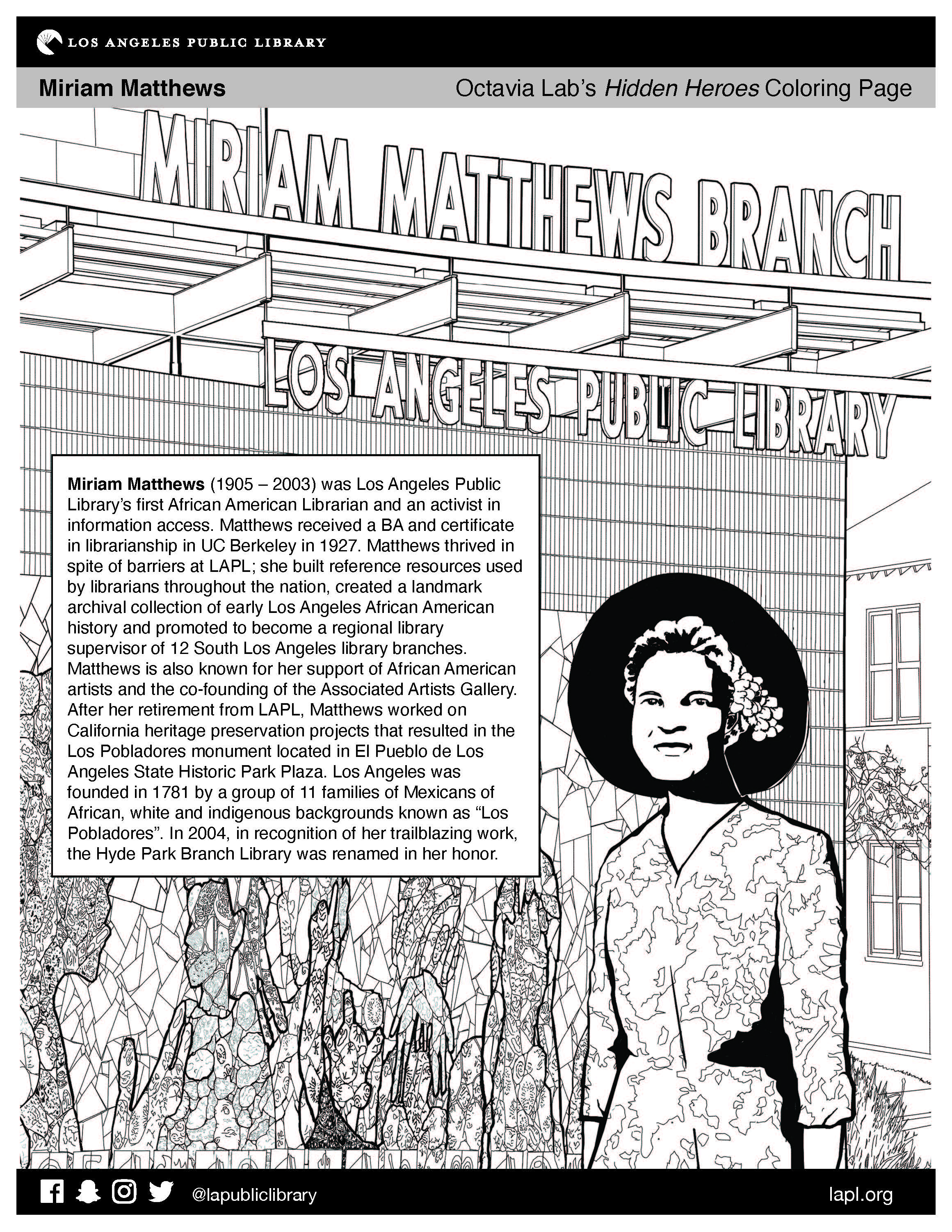
The Octavia Butler Maker Space at LAPL has made coloring pages of LA's hidden heroes publicly available for download along with an interactive map wideget Here is the one for "Miriam Matthews, an activist for information access": https://octavialab.github.io/Hidden-Heroes-Historic-Places/#23
From Intellectual Freedom to Freedom of Intelligence
Matthews modeled what it looks like to fight for the freedom to know, across race, politics, and profession. That example is what intellectual freedom in the 21st century needs.
As I consult library historians and critics to trace the early American genealogy of intellectual freedom, her work joins other traditions - philosophical and literary - in grounding what I am developing as its successor: "freedom of intelligence" for all human flourishing.
Your feedback and comments are welcome.
Notes
Crawford, Holly. (1997). Freedom through books: Helen Haines and her role in the library press, library education, and the intellectual freedom movement. Thesis submitted in partial fulfillment of the requirements for the degree of Doctor of philosophy in Library and Information Science, University of Illinois, Urbana Champaign.
Hyde Park Miriam Matthews Branch Library website. https://www.lapl.org/branches/hyde-park
Matthews, M. (1959). Improving the book collection: weeding and replacements: paper presented at the Univ. of Southern Calif. workshop. California Librarian, 20, 232–234.
Matthews, M., & Matthews, M. (1961). Improving the book collection. Oklahoma Librarian, 11, 57–58.
Matthews, Miriam. The Negro in California from 1781-1910: An Annotated Bibliography. Unpublished research report, University of Southern California, Los Angeles, 1944.
Matthews, M. (1945). Library activities in the field of race relations.
Matthews, M. (1947). California library association and California librarians join censorship fight. Library Journal (1876), 72, 1172–1173.
Matthews, M. (1945). Select Bibliography. Journal of Educational Sociology, 19(3), 198–206.
Matthews, M. (1959). Improving the book collection: weeding and replacements: paper presented at the Univ. of Southern Calif. workshop. Calif. Public library.
Miriam Matthews, August 6, 1905 – June 23, 2003). Wikipedia. https://en.wikipedia.org/wiki/Miriam_Matthews
Oliver, Myrna. (2003, July 6). Miriam Matthews, 97: Pioneering L.A. Librarian was an expert in Black History. Los Angeles Times.
Pearson, C. A. (2006). Hyde Park Miriam Matthews Library. Architectural Record, 194(5), 148–151.
Wallace, Kelly. (2021, March 5). The incomparable Miriam Matthews. LAPL Blog
Tribute for Librarians We Have Lost – ALA Sesquicentennial Memories 1976–2026
------------------------------
Anita Sundaram Coleman, PhD | Infophilia, A Positive Psychology of Information
------------------------------